Showing posts with label Salem Witch Trial. Show all posts

Thursday, May 9, 2013

Without Puck, part 2: Enchantment

So much for the incantation.

The incantation is the thing that connect the physical object to the metaphysical or unconscious or subterranean world. For John Kembal it was Goody Martin's declaration "I'll give you puppies enough!" that led to the inebriated hallucinations. It is when someone hums the first two lines of "You Are My Sunshine" (or just happens to write it in a blog), and there the song stays in the mind, irritatingly permanent. The words invoke, but the enchantment is entirely of the subject's, not the enchanter's, doing.

Marion Starkey tells us that the Salem witch trials began due to the tendency of girls in Puritan culture--girls on the verge of adulthood, who were, in Starkey's words were "without Puck"; and could not find relief, especially in winter, for their energies and imaginations--that these girls were, essentially, bored. Their angst had not the outlet we have today: to scream out of fast moving car windows, to dance, et cetera. In lieu of any avenue for imaginative retreat (which was repressed out of society, in the sense that most other books and stories were falsehoods and therefore in the Devil's domain), Abigail Williams (only eleven, whatever Miller writes) and the rest of the girls found a new sanctuary in the stories and ju-ju of Tituba, who spent all winter weaving tales and incantations across and around them.
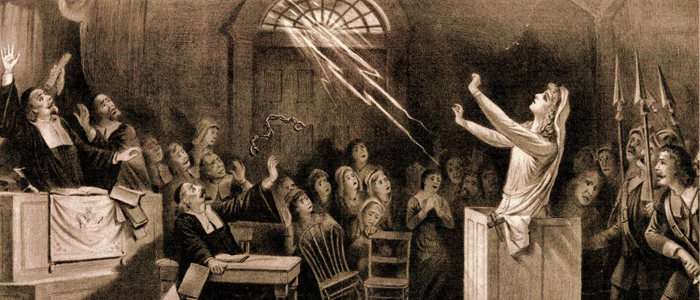
This scene is as much an internal creation as it is an external force.
When they were discovered, this much we know, every bit of those repressed energies was harnessed and ready to explode. The girls, without an imaginative or creative outlet, and the ability to become outrageously excited, became "the afflicted girls." They were overtaken: it is important to note that it was not a spell but their own enchantment: that Tituba merely made an incantation, not a spell. The spell was owned entirely by the girls.

Likewise, when the region came to be possessed with what can only be described as Lust in condemning witches, it was not the afflicted girls who enchanted, but rather the townspeople's own conscious and unconscious behaviors. The town began to create a reality, possessed with the imaginative spirit of Lucifer first (and God, ironically, only secondary, in that it was God's work to capture and kill any witch in their midst), and the reality was autonomous to any real enchanter. It cannot be blamed of the girls entirely that the judges condemned the witch, just like it cannot be blamed on the witch that the girls were able to create such real harm to themselves, pain that they truly believed in.

Puritan Massachusetts fell into chaos. Witches were found in all corners of the villages. A woman walking past one of the afflicted might cause for no reason she could see real harm to the afflicted girl. But the witch did not do the harm: it was the girl's imagination. Once the incantation takes place, it is only upon the enchanted to continue the spell, which is a kind of a metaphysical reinterpretation of Eleanor Roosevelt's famous quote, "no one can make you feel in inferior without your consent." And there were choices involved, to the self-enchanted. As much as the world seemed to be full of external forces, it was instead internal creation and imagination.

In poetry, then, the incantation releases the poem, the craft, into the waters of the imagination. But it is the reader or reciter of poetry who allows that poem to grow. In this sense, I can think of poem after poem that has lingered in my head without stop, entirely enchanting me but of my own enchantment. To another, it would appear boring, it would not have the effect. But this type of enchantment does recall to mind a poem by Walt Whitman:

When I Heard the Learn'd Astronomer.

When I heard the learn'd astronomer ; 
When the proofs, the figures, were ranged in columns before me ; 
When I was shown the charts and the diagrams, to add divide, 
      and measure them ; 
When I, sitting, heard the astronomer, where he lectured with                   
      much applause in the lecture-room,
How soon, unaccountable, I became tired and sick ;
Till rising and gliding out, I wander'd off by myself,
In the mystical moist night-air, and from time to time
Look'd up in perfect silence at the stars.

The simplicity of meaning, almost an insurrectionary impulse in the speaker to resist science for the sublimity of the natural world, is complicated by the fact that the speaker had nevertheless "heard the learn'd astronomer." The words had been spoken, and spoken again, into the poem. The enchantment is upon the speaker, and is the speaker's enchantment, the astronomer's lecture. The lecture reprints itself onto the night sky. The silence of the stars includes the lecture of the astronomer. There is no separating the two. And it is not the astronomer that enchants the night sky, but rather the enchanted, writing the lecture into the sky. 

In Whitman's poem, the external forces may seem to be the Astronomer and Nature. But Whitman internalizes both, by making them equal subjects of the poem. They are projected out in an act of creation, harmless of course (not at all as dangerous as Abigail Williams' projections) because they have enchanted, and the enchanter must act. The poet is always the enchanted object trying to release the spell from himself.


Saturday, May 4, 2013

Without Puck, part 1: Incantation


There is a case to be made that the fantastical should notbe ignored. Even if modern technological advances have smoothedout the supernatural or religious contours of the human imagination, childrenstill believe there are monsters in the closet.

That’s because there are monsters in the closet. If we wantthere to be.

Cover of "Wonderland" series -- David Mack, artist

An anxiety edging its way to the hegemonic front can be seenin two comic book series. The first is by Mike Carey, called The Unwritten, theother is the ninth season of Joss Whedon's Buffy the Vampire Slayer, in which all magic hasbeen destroyed and locked out of the world. In both comics the creative forces that are connected to the world (in Carey's a giant fish called Leviathan; in Whedon's world, magic) have been somehow severed. It should be noted that in both cases the severing was violent. It requires violence to sever the imagination from the mind. This violent act has left the world without dreams. Suicide rates are up, creativity is down. In the words of Willow (who had her own spectacular five-part comic in which she tries to rectify this problem), Buffy's wiccan sidekick, "no one can hit a note, everyone's auto-tuned."

In Carey and Whedon's world, the link is the incantation. The incantation, the words to create the spell, to create the fiction, to make it physical, to make the link occur. 

There are supernatural causes to these problems, and in these comic book series there can be supernatural solutions. In a way their creations show the reverse of that cultural anxiety: the fact that these two can create a world threatened by the disappearance of creativity is proof the imagination in our culture is far from tapped. But it is nonetheless an anxiety that corresponds to our "end of days" anxiety. Not only will the world be zombified, it already is.


A society we could be paralleling ourselves to (I see this is a grandiose statement, but I'm inclined to make it and hope you are generous to me) is Puritan Salem in 1692. Here, as Marion Starkey wrote in her book "The Devil in Massachusetts," the people of Salem, denying the "natural outlet in Robin Goodfellows and in fiddling and dancing around the maypole," had focused its repressed imaginations into dark accusations of witchcraft to a number of goodwives. One of them, Susanna Martin, had been assumed to have her exploits in witchcraft, and was "something of a Paula Bunyon among witches" to the townsfolk. As early as 1669 she had been accused of witchcraft.

One of the best stories of Susanna Martin was how John Kembal had been harassed by metaphysical dogs while walking home from the fields. Earlier in the day, Kembal had visited Goody Martin with the intention of buying the litter her bitch had just had. When he decided against buying the litter, Susanna "was wroth. [. . .] 'I'll give you puppies enough!" she cried after him. And indeed she did."

That evening Kembal was visited by the apparitions of puppies as "he came out to the road near the meetinghouse." When he tried to kill the first puppy with an ax, it disappeared. Farther along, a "Thing" awaited him, "a larger puppy, black as coal and vicious. It sprang for his throat, his belly . . ." Kembal swung with his ax wildly and it finally disappeared when he called out Jesus' name. 

That's some good incantation. Of course, the pailfuls of beer the kitchen maid brought to Kembal on the field might have created the physical manifestation: so it is unclear who we should thank for the supernatural story: the witch, the farmer, or the beer. It would be best perhaps to put value on all three. As for Goody Martin, who was executed on July 19th, 1692, although it was she who made the incantation, it is unclear whether it was herself proper or Kembal's vague idea of her as "witch" that is to blame for the apparitions. 

The incantation, in poetry, is the bucket that dips into the imaginative well. It is the first light found in a dark room. It lights. The child says "monster," and the clothes in the closet begin to shift. 

Take, for example, a poem by Brenda Hillman from Practical Water (Wesleyan, 2009)

"In The Trance"

A pretty anarchist said to me
It's not that a great love happens
what happened became your great love

Her echo had an ancient glow & so
proved buoyant for my little craft

I left the world & felt the world

The bee loading it gloves with powder
The albatross wanting one thing from the sea

Nothing can wreck our boat said she

& when the water felt the glacier
The future held a present tense
The present held a future without cease

Like Goody Martin incantation to John Kembal's visions, what the anarchist says "proved buoyant for [the speaker's] little craft". The craft is two-fold: a vessel and an art. As a vessel, the incantation releases it into the world. As an art, it is the bucket dipping into the well and the poem is what is drawn. John Kembal's craft was metaphysically his imagination, and physically the beer. 

Every morning should come with an incantation. Each morning we should write in the declarative, and watch out for how the incantation shapes the day. This is about being aware and not: allowing our unconscious mind to do a lot of work so our physical reality can manifest itself into the supernatural. Then we'll write about it.