Friday, February 21, 2014

Throwaways: An Heroic Crown of Sonnets ~ now for sale!

Chapbook now on sale!


Here it is!

For those that missed my poem-a-day challenge last June, as part of a fund raising challenge for Tupelo Press, my first heroic crown of sonnets has been published by MollyDog Press and is available for purchase, only $10!

These sonnets, written and revised in a day and inspired by terms from Brewer's Dictionary of Modern Phrase & Fable, bounce along in experiments of sound and rhythm. They gyrate they cough. Sometimes it gets kinda lewd. That's okay. You see, they are Throwaways.

In a lovely little book, designed and printed and bound by local hands, including a handsome cover art by local Portland artist Allison DeWilde, you'll enjoy reading and rereading good old fashioned post modern American poetry.

Here is a sample poem, for free:

xii. [lover's acronyms]

Seek recourse true and artless able craft,
seek location's counterfeit corner-code,
I'm for BURMA from EGYPT's twining road.
Too far to hear the near-naught half hurt laugh

or the open stomach of I MISS YOU.
When pressed, the ink between letters gives way,
lovers' acronyms caught in fine array
tell dirt, tell sway, in seeking shall you view

a word's wanton coil cleaved, a refrained fate,
recall to love a meaning, a word a freight,
to skin and buckle, its fixed figure staffed.

Telling to us a longing for to find,
a motto rented, a found song refined,
the Janus words leap to fuse forth and graft. 


As this is a continuation of a fundraising effort, 20% of all sales go to Tupelo Press. The rest helps me continue to write poetry, and especially submit my professional poems to literary journals and contests that require an entry fee.

Chapbooks are also for sale at Wallace Books, in southeast Portland, Oregon. 


Wednesday, July 3, 2013

Tupelo 30/30 Fundraising Project: Second Heroic Crown: "The Warsaw Crown"

I'm writing a poem a day for thirty days, part of Tupelo Press' 30/30 Project.

Not only have I taken the challenge of writing thirty poems in thirty days, but I've also added to the challenge by writing two heroic crowns of sonnets, the first heroic crown (entitled "Janus Words) having been finished yesterday. Now I'm starting on the second crown, which I'm entitling "The Warsaw Sonnets." They are for my wife's family in Warsaw, Indiana, and are taken from prompts of local/folk words that come from that corner of the country. Please look to those poems and other poets' work here.

I'm enclosing the second sonnet cycle below. Please DONATE TO TUPELO PRESS if you enjoyed these poems. Your donation does not come back to me: this is a volunteer challenge, and a fun one at that. Instead, your donation goes to help Tupelo Press continue to publish outstanding poetry, including (for instance) Dan Beachy-Quick's marvelous poem "This Nest Swift Passerine," which I highly recommend you buy.

When you DONATE, please remember to write in the "Honors" field my name, so Tupelo knows you are recognizing my work as the reason you are donating. Whether you donate $1 or $50, please enjoy the poems posted below. At the end of the month I'll post the next sonnet cycle. Thanks!


Warsaw, Indiana.


T H E  W A R S A W  C R O W N

Copyright © J. Kirk Maynard 2013

Part of the Tupelo Press 30/30 Project.

To make a donation to Tupelo, click here, scroll down to the “Donate” button and follow the instructions. Remember to write J. Kirk Maynard in the honors field so your donation is recognized as honoring these poems. And thank you.


II. i. [will it play in Peoria?]

Here is a crossroad set, a circumstance :
thin line of was to what ifs is given
a harder back, stiff legs country-driven
or brought to ear in mean sustenance

and discount sales. The smooth open bay
of moon in pasture on a thin grey road,
sharpened silence written only as owed,
the question to ask this crown : will it play

in Peoria? Here are my short words
to find a journey made at left or right
turns : a poem to craft a country lane.

Within the dust and ears of corn and soy,
a whispered tongue invisible, and cloys
the lyric pastoral, the mouthing grain.


II. ii. [corny]

The lyric, pastoral, the mouthing grain
jumps the crown twice in unfruit-filled relish.
The first is vegetable. What’s nourished gains
in teeth kernaling through the buttered flesh,
sound-smack the muggy air of summer once
removed. The second is internal rhyme,
to stories played in pastor’s abundance,
for how to make holy water? In time
you boil the hell out of it. Corny
is what it’s called when it sticks to your teeth,
when you gum past the prayers a stormy
mind set and settling still the rind beneath.
The well-spoke spatter of flesh and word
makes her round-up cozy in winter whorled.


II. iii. [cherry bounce]

Makes her round up cozy in winter whorled,
a cough corrupting the once silent house
through din of den T.V. Who needs a dose
of Grandma’s medicine, of bourbon curled

in fruit and kept in the kitchen’s cabinet.
She calls it cherry bounce. It’s ages old,
smelling of gas light and a country told
to fend for itself, be compassionate,

and build your home. The jar in quiet rest
is briefly pulled to rise and warm the chest
within, but more is wrought, a circumstance :

a memory of warmth and care and love
cupped in temperance, a sort of sin of
utility, a sneaking decadence.


II. iv. [farmer’s turn]

Utility a sneaking decadence,
there’s the straight line of road and here’s the turn,
here’s where the speed of fifty-five adjourns
unless the farmer may through excellence

he to the opposing lane, drives himself.
We are free to carry on at a speed
lifted by a consummate caring creed
of respected manners, of witnessed selves

and approaching windmills. The open road,
sought by opening at the farmer’s turn,
the bleeding broken line’s a farmer’s tool,

and the yellow markings a transit code.
What sense of goodness reigns and generates
a road where traffic all accelerates!


II. v. [whistle pig]

A road where traffic all accelerates,
a land still serene in the dusty air :
hides opossums, hides decorate deer
the space between highways, a venerate

menagerie, even the raccoon stalks
the wood bins snow-side a snuffling gruff,
the foxes and frogs, whistle pig in slough
or creek or to hibernate under rocks.

The air is silent calm, muggy summer,
kids play tag beneath the yellow poplar,
the whistle pig whistles out a warning :

man is in the forest. Come close to dirt,
dig beneath their findings into warm earth.
There they live all giddy in conforming.


II. vi. [Hoosier]

There they live all giddy in conforming
to shadows wrought by crossroad rearings
impulses turned in tune to deer clearings,
The wholesome Rockwell, the roomy warming

up of Hoosier. The old man drove his hog
as far west as Sante Fe and saw
The southwest, as far ground as he could claw.
The blessing first as a Hoosier, he prologued,

was to be one. The second was the getting out.
His mouth's mustache trembles in a split shout
of laughter, nods. Proud to be serene.

 If I could live again said he musing,
The only laugh-loud bang I'd set fusing
I'd imprint Hoosier on someplace obscene.


II. vii. [snipe hunting]

I'd imprint Hoosier to someplace obscene,
a chicken ranch, perhaps a coughing up
of caterwauling to stranger's gulling gulps,
the snipe hunting when snipe is just a screen

for me. I’ve been duped to camouflage,
a secret untethered lies in my chest,
cared by false curiosity at best,
at worst a grown man swept in sabotage.

Your love was best for the startling,
for windows unforeseen at first second look,
my first look twice I could not see the trick

of your two eyes hunting for mine halting :
when you said here's a trick I might have took,
the snipe you've sought I've led to lead you quick.


II viii [clink of glass]

The snipe you've sought I've led to lead you quick
To counterment, cold and calculated
The bride and groom sit in first vows sated,
Till clink of glass rings and lips must kiss

Or the ringing perpetuates. We were wedded
In vibration, the audience
To sound in certain ticklish ambiance
And trapped by tapping knives in embedded

Rhythms of love. O Jessica, I hear
Each ring as I awake and find you near
The noise an infectious sound of devotion :

You are made of champagne flutes awry,
A dear dear sound I set my love by,
To love the glass that caught the promotion.


II. ix. [Restart your Engines]

To love the glass that caught promotion,
a sure bet, an open commotion,
the less for land open and brightly lit,
From Midwest to Pacific now I sit

and dream of better poems than this.
The hours we spent just now to this,
a sitting after long days in Missoula,
means my mind is wiped of cadence or rhyme.

Let’s follow the Indiana slogan :
to restart your engines! and get going
tomorrow, with a better poem than this.

For now I’ll spend the last hours of day
with you rather than writing away
at rhythms when thrown forever miss!


II. x. [outer road]

At rhythms when thrown forever miss
main stream meandering or they seem posed,
in the outer road I drive to transpose
the main from mean, what speeding signs dismiss

and carefully select the ground to topic on.
Was it that you too, shook to see up close
what stranger ways a gravelling road shows?
Our mutual winding was toward us drawn?

I think we’ll find in frontage roads a home
to stand nearby the main for those that roam :
the picture window dream without the ritz.

We need it now more than before, what seems
a stranger’s road opens in sun caught sheens,
toward periphery, toward forgotten glitz.


II. xi. [barn burner]

Toward periphery. Toward forgotten glitz,
what is earliest love but a real barn burner?
From the compass, two opposing points
one city rhyme, one country song, sterner
than can agree the continent divides.
We reel between the two, a love of long
distance and the close proximic street slides.
This is what’s keeping us a heavy run :
the days we drive past corn and close cropped fields,
the nights we heel-clap the concrete even,
in better burgs, empty mill towns, crop yields,
yields sway to stay being alive, breathing.
Jess, if we ever from this hot love hiss,
let’s remember the continent’s a kiss.


II. xii. [knee high by the fourth of July]

Let’s remember the continental kissed
interior, and drives itself up high :
in county Kosciusko summer’s sky
distant dealing in constant crushing, this

requires literal measurements made.
What miles when and readings taken in,
the figure-face, supposéd how and when
distorts the sensibilities and aids

tomfoolery. One conjecture is owned,
for farmers often may to one intone
knee high by the fourth of July.

How to measure knee? How to measure corn?
This thumbed rule is one that is not scorned,
sights to guide all literal others by.


II. xiii. [angel]

Sights to guide all literal others by
resemblance struck, by pure lightning chance:
the hobos say an angel hovers a glance
without recompense asked, nor neither sighs

nor feels disgraced. Sometimes I'm silly-spoke,
a glib word said like footsteps on the track,
the lonesome quietude opens : I'm back
to feeling lost until you so invoke

the angel uncaring, allowed by sight
to stop my dumb phrasings in shallow light
of homeless verbs, of ill-begotten I's : 

seeking shelter in your moral compass,
my words aren't drunk that never can cut less
than true, your voice is home and I comply.


II. xiv. [smelling the barn]

Then, true, your voice is home and I comply, 
then home is the sweet stable smell snifted,
of smelling the barn, of low heads lifted : 
I am almost. Hard to see night's light by,

but by and by the surety sweet to say
these sonnets were honestly written here,
mincing words verbs subject I him you her,
day to day, and cheaply did rhyme give way

or tired I stopped taking care of it. 
Smelling the barn, I've taken to poor wit,
(anyways written an hour or less

of deadlined I, and deadlined my poor mind,
soon I'll be more blunt, leave sonnets behind,
each day a declaring of home's own bliss.


II. xv. [Warsaw, Indiana]

Here is a crossroad set : a circumstance,
the lyric, pastoral, the mouthing grain,
makes her round, cozy in winter’s whorled
utility, a sneaking decadence :

there we live all giddy in conforming
the imprint Hoosier to something obscene,
the snipe you’ve sought I’ve lead to lead you quick,
to love the glass that caught promotion

at rhythms. When thrown forever miss.
Toward periphery, toward forgotten glitz,
let’s remember the continent’s a kiss,

sights to guide all literal others by.
Than your true voice is home and I comply :
each day a declaring of home's own bliss.


Saturday, May 11, 2013

Without Puck, Interlude/Soliloquy : On Obssession

I dreamed a friend passed me in the street, Roosevelt Avenue, Queens, right under the F train; and said to me that I was wrong about the first two parts of this essay. I awoke considering the nature of obsession.

Here are some preliminary thoughts on obsession and enchantment:

1) Vladimir Nabokov, in his autobiography Speak, Memory, referred to Lolita as (to paraphrase) a long and painful birth. No doubt there was inspiration for the characters, and we even get a hint to a girl Nabokov met in the Crimea that might been the seed for the pederast Humbert's own obsession.

To speak nothing of Nabokov's own obsession, does Lolita, for the author and Humbert, qualify as an enchanter? I don't think so.
James Mason as Humbert Humbert in Stanley Kubrick's Lolita (1962)
2) Obsession is the enchantment's Janus-face. It, too, can take over a poet. I'm willing to say it has to do with the self enchanting the self: spell-caster & spell-bound. Obsession has less to do with external forces, although the impetus can be there. Obsession is usually premised with an incantation of self.

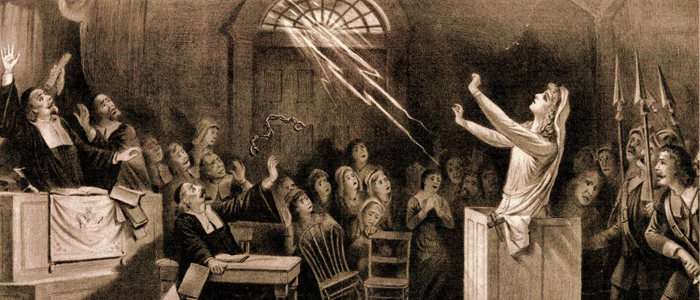
2a) Consider our enchanted Salem. The spell casters were external: Tituba and Goody Martin, only to name two. There were many more besides: almost anyone can cast a spell, can cause the enchantment to occur. The afflicted girls, the hallucinations of John Kembal, these were enchantments. They were cast by the incantation, brought externally into the internal workings ("afflictions") of the enchanted. Soon all of Salem was enchanted. It exceeded itself, it even found itself "afflicted" or "possessed." I would even say to some extent obsession became evident. Obsession, perhaps, was found in the religious leaders. We might be able to argue that Cotton Mather became obsessed by this, since he viewed all from a distance, his incantation might have been driven by himself. This is merely conjecture.

3) Dick Hugo: "We create our prisons and we earn parole each poem." (Letter to Birch from Deer Lodge)

4) In my dream, it wasn't the spirit of my friend calling to say you've forgotten about x and y, it was my own mind signalling to me. That is the creation by the self, the incantation of the self, the spell cast on the self. Poetry, too, can be like this, although I see some elementary dichotomies at play here.

4a) The enchanted/obsessed binary is linked to the binary set out by Lorca: the Muse and Duende. The muse is external to the poet, the sublime speaking into the poet's ear, the poet an enchanted vessel. The Duende is a demon-spirit, housed in the bowels of the poet, rising up out of the poet's own unconscious, being vomited forward. The Duende is a creation of the self, not always such a darkness as I have painted it, but a being that doesn't hold the heavenly or sublime light of the Muse and the Angel.

4b) The poet struck by the Muse is often found in address: the apostrophe is in use. "Sing to me, O muse" is the daily prayer of this poet. Not to say all poems that lack the expressive "O" are without the muse. Whitman's poem in the last segment shows the enchanted, in this case the Astronomer and the stars are the expressive "O," they are the external force.

4c) Likewise, the address can be made without realization that the obsessed is addressing himself. Consider Humbert's first spell-casting:

"Lolita, light of my life, fire of my loins. My sin, my soul. Lo-lee-ta. The tip of the tongue taking a trip of three steps down the palate to tap, at three, on the teeth. Lo. Lee. Ta." (Nabokov)

Here is Humbert's incantation, to himself. The Lolita which has a self is lost in the mouth of Humbert's incantation, becomes broken into pieces of sound. It is not Lolita who makes the incantation: she is Humbert's self-incantation. She does not enchant: he is already enchanted. It is a self enchantment: it is an obsession.

4d) To take another example of a character obsessed: who does Eliot's Prufrock really address if not himself -- or the self in visage? Prufrock enchants himself firstly, and then proceeds to enchant the rest of us; even Eliot is not immune. Prufrock is born of Eliot's mind, an obsessed Self actualized.

4e) With Humbert and Prufrock: they can and do enchant us. That is what the obsessed poet accomplishes. If the enchanted poet is able to spread the Word, the obsessed poet manages to spread the self. We actualize, we play accomplice.

5) I knew a boy of seventeen, who fell deeply in love with a girl the same age. They were both young and new to experience, but the girl had a better grasp on the realities of the world than the boy had. She had been visited by a demon, we'll call it Loss, early in life, when her parents had divorced. So the demon Loss was not a new thing in her life, and, like a second child, when each new Loss came they all became easier to carry.

Everyone carries Loss around, sometimes many Losses. Sometimes the burden of Loss can be too much. Most of us manage to find a way to let it sit inside us without it bothering us too much. A new Loss comes around and we manage to shift the other Losses around so as to make more room. Sometimes a particular Loss just leaves, and we come to forget its face, and we wonder what we were so upset with in the first place.

When the boy and girl were twenty, the girl broke things off, and the boy bore the first Loss he had had to deal with. And the boy tucked away that Loss, let it nest in his heart. He took Loss hard, is what I mean to say. Loss breathed fire into his ventricles and arteries until the breath of Loss tingled down every nerve in his body. It was wholly pathetic to watch.

Why this anecdote is particular is that the boy had been enchanted with the girl, but when the girl left she did not leave by still enchanting; instead, the boy allowed himself to be enchanted with his own Loss. This was obsession. This is the obsession of love unrequited: it is not the beloved, but the lover, the lover enchanted with the idea of Love or the idea of Loss, each one equally within the self enchanted.

That Loss that came from the girl eventually grew old and died. The boy also became older, learned to hold greater Losses at greater distances. Deaths of friends and family made the First Loss go to seed. It isn't that the First Loss is gone, for it could sprout from some organ of the boy at any time. For now, it lays buried, with a hard frost atop it.

Thursday, May 9, 2013

Without Puck, part 2: Enchantment

So much for the incantation.

The incantation is the thing that connect the physical object to the metaphysical or unconscious or subterranean world. For John Kembal it was Goody Martin's declaration "I'll give you puppies enough!" that led to the inebriated hallucinations. It is when someone hums the first two lines of "You Are My Sunshine" (or just happens to write it in a blog), and there the song stays in the mind, irritatingly permanent. The words invoke, but the enchantment is entirely of the subject's, not the enchanter's, doing.

Marion Starkey tells us that the Salem witch trials began due to the tendency of girls in Puritan culture--girls on the verge of adulthood, who were, in Starkey's words were "without Puck"; and could not find relief, especially in winter, for their energies and imaginations--that these girls were, essentially, bored. Their angst had not the outlet we have today: to scream out of fast moving car windows, to dance, et cetera. In lieu of any avenue for imaginative retreat (which was repressed out of society, in the sense that most other books and stories were falsehoods and therefore in the Devil's domain), Abigail Williams (only eleven, whatever Miller writes) and the rest of the girls found a new sanctuary in the stories and ju-ju of Tituba, who spent all winter weaving tales and incantations across and around them.
This scene is as much an internal creation as it is an external force.
When they were discovered, this much we know, every bit of those repressed energies was harnessed and ready to explode. The girls, without an imaginative or creative outlet, and the ability to become outrageously excited, became "the afflicted girls." They were overtaken: it is important to note that it was not a spell but their own enchantment: that Tituba merely made an incantation, not a spell. The spell was owned entirely by the girls.

Likewise, when the region came to be possessed with what can only be described as Lust in condemning witches, it was not the afflicted girls who enchanted, but rather the townspeople's own conscious and unconscious behaviors. The town began to create a reality, possessed with the imaginative spirit of Lucifer first (and God, ironically, only secondary, in that it was God's work to capture and kill any witch in their midst), and the reality was autonomous to any real enchanter. It cannot be blamed of the girls entirely that the judges condemned the witch, just like it cannot be blamed on the witch that the girls were able to create such real harm to themselves, pain that they truly believed in.

Puritan Massachusetts fell into chaos. Witches were found in all corners of the villages. A woman walking past one of the afflicted might cause for no reason she could see real harm to the afflicted girl. But the witch did not do the harm: it was the girl's imagination. Once the incantation takes place, it is only upon the enchanted to continue the spell, which is a kind of a metaphysical reinterpretation of Eleanor Roosevelt's famous quote, "no one can make you feel in inferior without your consent." And there were choices involved, to the self-enchanted. As much as the world seemed to be full of external forces, it was instead internal creation and imagination.

In poetry, then, the incantation releases the poem, the craft, into the waters of the imagination. But it is the reader or reciter of poetry who allows that poem to grow. In this sense, I can think of poem after poem that has lingered in my head without stop, entirely enchanting me but of my own enchantment. To another, it would appear boring, it would not have the effect. But this type of enchantment does recall to mind a poem by Walt Whitman:

When I Heard the Learn'd Astronomer.

When I heard the learn'd astronomer ; 
When the proofs, the figures, were ranged in columns before me ; 
When I was shown the charts and the diagrams, to add divide, 
      and measure them ; 
When I, sitting, heard the astronomer, where he lectured with                   
      much applause in the lecture-room,
How soon, unaccountable, I became tired and sick ;
Till rising and gliding out, I wander'd off by myself,
In the mystical moist night-air, and from time to time
Look'd up in perfect silence at the stars.

The simplicity of meaning, almost an insurrectionary impulse in the speaker to resist science for the sublimity of the natural world, is complicated by the fact that the speaker had nevertheless "heard the learn'd astronomer." The words had been spoken, and spoken again, into the poem. The enchantment is upon the speaker, and is the speaker's enchantment, the astronomer's lecture. The lecture reprints itself onto the night sky. The silence of the stars includes the lecture of the astronomer. There is no separating the two. And it is not the astronomer that enchants the night sky, but rather the enchanted, writing the lecture into the sky. 

In Whitman's poem, the external forces may seem to be the Astronomer and Nature. But Whitman internalizes both, by making them equal subjects of the poem. They are projected out in an act of creation, harmless of course (not at all as dangerous as Abigail Williams' projections) because they have enchanted, and the enchanter must act. The poet is always the enchanted object trying to release the spell from himself.


Saturday, May 4, 2013

Without Puck, part 1: Incantation


There is a case to be made that the fantastical should notbe ignored. Even if modern technological advances have smoothedout the supernatural or religious contours of the human imagination, childrenstill believe there are monsters in the closet.

That’s because there are monsters in the closet. If we wantthere to be.

Cover of "Wonderland" series -- David Mack, artist

An anxiety edging its way to the hegemonic front can be seenin two comic book series. The first is by Mike Carey, called The Unwritten, theother is the ninth season of Joss Whedon's Buffy the Vampire Slayer, in which all magic hasbeen destroyed and locked out of the world. In both comics the creative forces that are connected to the world (in Carey's a giant fish called Leviathan; in Whedon's world, magic) have been somehow severed. It should be noted that in both cases the severing was violent. It requires violence to sever the imagination from the mind. This violent act has left the world without dreams. Suicide rates are up, creativity is down. In the words of Willow (who had her own spectacular five-part comic in which she tries to rectify this problem), Buffy's wiccan sidekick, "no one can hit a note, everyone's auto-tuned."

In Carey and Whedon's world, the link is the incantation. The incantation, the words to create the spell, to create the fiction, to make it physical, to make the link occur. 

There are supernatural causes to these problems, and in these comic book series there can be supernatural solutions. In a way their creations show the reverse of that cultural anxiety: the fact that these two can create a world threatened by the disappearance of creativity is proof the imagination in our culture is far from tapped. But it is nonetheless an anxiety that corresponds to our "end of days" anxiety. Not only will the world be zombified, it already is.


A society we could be paralleling ourselves to (I see this is a grandiose statement, but I'm inclined to make it and hope you are generous to me) is Puritan Salem in 1692. Here, as Marion Starkey wrote in her book "The Devil in Massachusetts," the people of Salem, denying the "natural outlet in Robin Goodfellows and in fiddling and dancing around the maypole," had focused its repressed imaginations into dark accusations of witchcraft to a number of goodwives. One of them, Susanna Martin, had been assumed to have her exploits in witchcraft, and was "something of a Paula Bunyon among witches" to the townsfolk. As early as 1669 she had been accused of witchcraft.

One of the best stories of Susanna Martin was how John Kembal had been harassed by metaphysical dogs while walking home from the fields. Earlier in the day, Kembal had visited Goody Martin with the intention of buying the litter her bitch had just had. When he decided against buying the litter, Susanna "was wroth. [. . .] 'I'll give you puppies enough!" she cried after him. And indeed she did."

That evening Kembal was visited by the apparitions of puppies as "he came out to the road near the meetinghouse." When he tried to kill the first puppy with an ax, it disappeared. Farther along, a "Thing" awaited him, "a larger puppy, black as coal and vicious. It sprang for his throat, his belly . . ." Kembal swung with his ax wildly and it finally disappeared when he called out Jesus' name. 

That's some good incantation. Of course, the pailfuls of beer the kitchen maid brought to Kembal on the field might have created the physical manifestation: so it is unclear who we should thank for the supernatural story: the witch, the farmer, or the beer. It would be best perhaps to put value on all three. As for Goody Martin, who was executed on July 19th, 1692, although it was she who made the incantation, it is unclear whether it was herself proper or Kembal's vague idea of her as "witch" that is to blame for the apparitions. 

The incantation, in poetry, is the bucket that dips into the imaginative well. It is the first light found in a dark room. It lights. The child says "monster," and the clothes in the closet begin to shift. 

Take, for example, a poem by Brenda Hillman from Practical Water (Wesleyan, 2009)

"In The Trance"

A pretty anarchist said to me
It's not that a great love happens
what happened became your great love

Her echo had an ancient glow & so
proved buoyant for my little craft

I left the world & felt the world

The bee loading it gloves with powder
The albatross wanting one thing from the sea

Nothing can wreck our boat said she

& when the water felt the glacier
The future held a present tense
The present held a future without cease

Like Goody Martin incantation to John Kembal's visions, what the anarchist says "proved buoyant for [the speaker's] little craft". The craft is two-fold: a vessel and an art. As a vessel, the incantation releases it into the world. As an art, it is the bucket dipping into the well and the poem is what is drawn. John Kembal's craft was metaphysically his imagination, and physically the beer. 

Every morning should come with an incantation. Each morning we should write in the declarative, and watch out for how the incantation shapes the day. This is about being aware and not: allowing our unconscious mind to do a lot of work so our physical reality can manifest itself into the supernatural. Then we'll write about it. 


Wednesday, May 16, 2012

The Anachronistic Pasture

I have set myself up to be a critic of the Necropastoral, a movement more in love with the living dead-ness and "uncanny" offspring of cyberspace, rather than the pasture of the traditional lyricism which approaches the physical sublime a poet may seek out, by way of exploring, or sauntering. For the poem, the movement out into the pasture, as a place for the poem, is for Joyelle McSweeney, a move toward anachronism.


It isn't hard to see how right McSweeney is, even if I wish she was wrong. An example is a recent eChapbook published by Blue Hour Press, No Silence in the Field, by Rachel Mennies, a lovely book of poems capturing various voices in the rural farmland of New England. The setting alone puts itself in danger of anachronism (where is Robert Frost these days?) so there's a sense that, even if we are temporally in the present, the present is ambiguous, where even appliances such as "the Kitchenaid whirs by the old feed storage" (13) is suspect. I feel this is deliberate on Mennies' part. "Rural" is a space pregnant with possibilities that soon miscarry; not a bad analogy, since miscarriage is a central tension in Mennies' book, climaxing in a beautifully heart-breaking poem "What Killed All the Bees" (24). 


It is the chapbook's final poem, "Morning, The Diggers Break New Ground" that the miscarriage of the New England farm is seen in full, the planks of the barn being taken down for new houses. "Time for the miracle of multiplying / strip the barn walls and make ten houses / where one once thrived" (30). The death of the barn bears an uncanny progeny. This is the living present, where what characters we knew are now discovered by means of their antique possessions, already beginning to rot. The conclusion is a dismantling of a landscape, perhaps the natural end to any rural image, but its a cynicism I'm not yet willing to share. 


This post mostly wished to present Mennies' book, which is lovely, so go read it. I remark only on our present dilemma of being unable to write the rural/agrarian into any contemporary present. Later posts will look at poems that are attempting this, and how they succeed or fail.

Tuesday, May 15, 2012

The Poet's Journey

Among his many epithets, including hodio, patron of travelers, the Greek god Hermes is also oneiropompous, conductor of dreams, and psychopompos, conveyer of souls. Hermes is guide physical and spiritual, the god of the Poet, guiding the poet through the "membrane" of the uncanny before Apollo descends with the lyre Hermes made for him. Hermes directs the poet to the steps of the Delphic Oracle, to an audience with the underworld Queen. Hermes arrives in daylight undisguised and impregnates first.


In 1929, a young man went to a crossroads in Mississippi and at midnight the devil taught the young man to play the blues. Robert Johnson had to travel to lose his soul for the sake of the blues.


The poet must explore, and be guided, in order to achieve blessing. This is Thoreau's saunter -- or sans terre, to be without land, or to be a pilgrim, a holy-lander, a Sainte Terrer. This exploration is either physical, psychological, or both. As often is the case in American poetics, Dickinson and Whitman mark the dividing line: when Dickinson starts early and takes her dog, the mental/spiritual/psychological processes of the world soon overpower her. It is the walk that begins it; for Whitman, it is not psychology but the physical environment that leads to the expression of deep sublimity. Whitman is not prone to keeping it inside, rather "sounds his barbaric yawp" upon the multitudes and democratic masses of his landscape. "Crossing Brooklyn Ferry" is my favorite example of such a physical exploration. 


In the 21st century there seems to be two sites of exploration. The first is cybernetic, attached to the open window of the browser, the endless page on page that I believe is Joyelle McSweeney's real "necropastoral." It is the living dead-ness of cyberspace many of us sit down to day after day, aware a living world beyond our screen; but "disconnecting" is now a very strangely disconnecting experience. This cybernetic ground is a psychological space, and poetry invested in this space is more psychologically uncanny than other spaces, linking it to the darker realms of the Romantic and lyrical poetics, such as Coleridge or Prospero. In further posts I will explore examples of those poems.

Joshua Carey in a post from last year, questions the poetry that leans toward the uncanny, a poetics he sees as passing through Olsen's lineage and is (I would say) given more clout as the landscape of poetry moves from the book to cyberspace. Here things are even weirder. But Carey calls for moderation: "There has to be a role for the rational, even a humbled and supplemented rationality, in a poetics that is nonetheless not instrumental but re-open the foreclosed world."

To me, this is remembering what lives beyond the window of the screen, what is the world "out there." That is physical exploration, with its reaches into the uncanny and the real. But I must move even farther from what is popular today, and that is to say that even the urban landscape is a place deadened by the psychology of being urban. It dangerously treads through malaise, the morose and the cynical so its uncanniness is even more putrid and dangerous. It has no renewal, no love. It seeks out the pastoral to moderate its discomfort. Rather than allow the rural and pastoral to do so, I propose we begin to explore once more that state of being, more naturally the space of Whitman and Dickinson and Thoreau. This is western poetry, the poetry of landscapes where human beings play little part. I propose we bring the poetics of the pasture back into the American landscape. Robert Johnson had to go to the crossroads to sell his soul and learn his instrument. We too must take that journey.


Wednesday, April 11, 2012

Kicking Gravel Re-Boot

Why Kicking the Gravel?

1. Look to where the gravel goes once it's kicked: it is a sprayed action. Once the dust settles, there is little that has changed. To kick gravel is to make a mark that goes unnoticed. Each pebble is likely to make sense here as it is here. Little is changed when gravel is kicked, unless the gravel is thin and the foot's mark is noticeable. Symbolically the gravel represents poetry. If this blog makes a mark we'll know that poetry is exceptionally thin.

2. The gravel I kick may go entirely unnoticed, but for You, who may or may not have stumbled here to watch the splayed action of a kick, or perhaps kick a little yourself. The kicking motion immediately makes transient what wasn't before, but very quickly it goes unnoticed. Your eye tilts back upward to the web address, in search of something else. Generally you only kick gravel when by your self, or with someone so close as to kick gravel with you, also your self. This is such a place for me.

3. "Why do I feel no shame, kicking the loose gravel home?"
~ Richard Hugo, "White Center"

4. There are two ways to kick gravel: the first is incidental, the second is with purpose. The purposeful kick is often done on the walk that is to go no where, on the saunter, as it were, and the moment of kicking gravel is a moment to affect the physical world because one has nothing better to do. The other option of the purposeful kick is catharsis, and I guess on a blog that might happen too. Whatever emotion is pent up in the self is expressed by the scattering of pebbles forward, which clearly become invisible in the gravel they landed in so that whatever emotion might have been in them as they flew forward, whatever energy was expended at that time is no longer noticeable and the eye moves to the next page. I do not intend for this to be a place for that sort of catharsis.

The incidental kick is whatever one does on a walk -- we are consistently, as moving objects in the world, affecting the world in which we live. A stumble, a shuffle, a leg moving forward can easily kick without intent. Just as any word placed onto the world wide web has its own place, incidentally, it can be pointed to for meaning, although lost in its surroundings.

5. The gravel road is a road that straddles the city and country. It straddles the natural and the artifice. It is itself a hybrid of what is natural and artificial. Unlike concrete, gravel gives the peripatetic a feeling closer to the Earth; unlike earth, gravel is a man-made process, however close it might be to what a river can do. Poetry also balances between its artifice and what it represents. Entirely man-made, it seeks to be as close to what artifice it is rather than be wholly (concretely) with man.

Not every poem is really that way. Some poets have made poems that are closer to concrete than to earth. That will be a subject of a later post.

Saturday, November 5, 2011

More to Say McSweeney

I suppose engagement with the necropastoral is something chronic: like hours of playing Snood the connections, implausible, become sustained even when you close your eyes.

Link to Joyelle McSweeney's latest, wonderful, post on bug-life and the poet. What I got most out of this was that our poetry is like the generations of bugs: die 150 plus times a year. Echos of Hugo: "we build our prison and earn parole each poem." In a hyperextended world (link : everything) our corpses may be everywhere, and with each new reading we are in a way animated only to die again. Who are you who got to this question mark -- ?

So why not write everywhere. Walls are for graffiti, threads can be tied onto thread. What it is is zombie-ness, but I think there's more optimism than just that. Not the world as dead and rotting (it is) but the world in language dead and reborn (it is).

Put economically, language of communication -- dead already. Language simply to communicate dies at the moment it communicates: self-destructing messages Chief Quimby can never get out of his coat in time. This kind of language eventually burns. Cynics say the new-speak begins and language rots. The poet plants eggs on the rot and is reborn a thousand times. The poet says new-speak and thinks up twenty nouns that are now verbs. (I'm roading it, I tonicked by gin, I Ricola'd my throat.)

Joyelle:

"I reject the so-called economy of corporate time, capitalist time, so called ‘linear’ time, triumphalist time, which is a golden lie anyway, and instead I recognize this tide of shit and waste, I recognize that that is where I live, if I live, on bug time, on bug time; in Indiana, in the necropastoral; I have no interest in myths of posterity, in a secured future, in the supposed future of literature or humans or anything else; the way I’m writing now is disposable; in disposible media and unsturdy genres; but it’s the most important thing in my milisecond life; that’s why I want to be wear my grave clothes now, ceremental, distressed, and yes, bug-eaten, moths in my hair, Miss Death-in-life, like PJ Harvey in her Mercury clothes, mercury poisoned, one part Miss Havisham, one part Gregor Samsa, with chitinous extensions shoving out from her brain through her cranium, her dura mater (tough mother), her pia mater (her little mother), her arachnoid mater (spider mother). Stabat, mater, my black pincers stabbed you in the eye, and now I’ll plant my eggs there, time flowing backwards, you carry the eggs again for me."

Take a text message, say "lets meet @4 Egan's."

Take a text message, say "sidled, slid, billiard boys I'm wasting my life."

Language slips back into the pocket of the reader, one way or the other. What happens in the world outside the language has always been anybody's guess but well known it is that you got to the end of this sentence and may turn around and read it again. Or hyperlink.

But that is urban. Go out to the pastoral and bring your urbanity with you, yes. Speak your new verbs to the plains, or hills. Or mountains. The only thing dead is the sound you just let carry. Nature isn't in a caring mood. Hyperlinks are not in place. Mountain time has no concept of linear, it is metamorphic or basalt. We know our searches inform the advertisements on the margins of our screen, we have been profiled by corporations and are a profile with a picture. This isn't about consuming, it is about producing on the consumption, and when we die of consumption (pun is there and I keep it there) we are born out of it again.


Wednesday, September 21, 2011

Joanna Klink and the Necropastoral

To my friends I give many books, usually what I would consider good reads. It is usual, however, that when I pass on the poetry of Joanna Klink the receiver, upon reading, is usually left cold.

"It's just too lyrical," they say, which I suppose is fair. Klink is deeply rooted in the lyric pastoral, a pastoral that may be dated for the millennium.

There have been some new theorizing on the pastoral, mostly from the blog Montevidayo featuring Joyelle McSweeney and her concept of the Necropastoral. From what I can understand (and correct me if I'm wrong), the idea is something like this:

The pastoral has always been synonymous with a kind of wilderness that is itself an anachronism of city life. That is, the pastoral is the reflection of the city cast out into a space that is occult, a fable, a fantasy. It has been appreciated and celebrated for its "other-ness" but it merely reflects the city's own decay in a larger space, since it "contaminates" itself with a kind of past glory in the present tense. It is a death of itself in the making, always.

As readers of poetry, we've come to expect this in lyric pastoral; in fact, it is what we are anchored to. A.R. Ammons "Visit," in which the poet, inviting you the reader to his place in the woods, advises the reader to "treat yourself gently: the ascent thins both / mind and blood and you must / keep still a dense reserve / of silence we can poise against / conversation: there is little news . . ."

The celebration of an anachronism. The desire in present to be in a dead past.

Joanna Klink, however, is one of the few poets who still believes in the pastoral as pure and devoid of the city and its pushy homages. I don't think she repudiates the necropastoral, but she certainly complicates it. It is not nostalgia we find in her landscape, but ardor. A yearning that must reject itself and the city. If that's the case her poetry finds itself nowhere, it is a negative of a positive of a negative. Here is the poem that begins her latest book, Raptus (Penguin, 2010):

Some Feel Rain

Some feel rain. Some reel the beetle startle
in its ghost-part when the bark
slips. Some feel musk. Asleep against
each other in the whiskey dark, scarcely there.
When it falls apart, some feel the moondark air
drop its motes to the patch-thick slopes of
snow. Tiny blinkings of ice from the oak,
a boot-beat that comes and goes, the line of prayer
you can follow from the dusking wind to the snowy owl
it carries. Some feel sunlight
well up in blood-vessels below the skin
and wish there had been less to lose.
Knowing how it could have been, pale maples
drowsing like a second sleep above our temperaments.
do I imagine there is any place so safe it can't be
snapped? Some feel the rivers shirt,
blue veins through soil, as if the smokestacks were a long
dream of exhalation. The lynx lets its paws
skim the ground in snow and showers.
The wildflowers scatter in warm tints until
the second they are plucked. You can wait
to scrape the ankle-burrs, you can wait until Mercury
the early star underdraws the night and its blackest
districts. And wonder. Why others feel
through coal-thick night that deeply colored garnet
star. Why sparring and pins are all you have.
Why the earth cannot make its way toward you.

Dream-state, death-state, beautiful annihilation. We are discouraged by her style because she will never offer us what we really desire, to die in a wilderness and awake inside our urban walls. If we die the door will open in a wilderness, but what we walk into is the unknown.

Monday, June 21, 2010

Poem as Prayer

from Dancing In Odessa (Tupelo, 2004) by Ilya Kaminsky:

Author's Prayer

If I speak for the dead, I must leave
this animal of my body,

I must write the same poem over and over,
for an empty page is the white flag of surrender.

If I speak for them, I must walk on the edge
of myself, I must live as a blind man

who runs through rooms without
touching furniture.

Yes, I live. I can cross the streets asking "What year is it?"
I can dance in my sleep and laugh

in front of the mirror.
Even sleep is a prayer, Lord,

I will praise your madness, and
in a language not mine, speak

of music that wakes us, music
in which we move. For whatever I say

is a kind of petition, and the darkest
days must I praise.

Another way in which the poet engages the reader is through the act of "prayer," usually on the outset of a book. Kaminsky's prayer is a steadfast and painful one, as a survivor who must now "speak" on behalf of those that cannot. The poet's address is one to a higher sort of being, or a statement of purpose. Not only can it be construed as the guiding light of the text (the rest of the book), but it may also set the tone.

Here is another sort of prayer, this time from Dan Beachy-Quick, from his book Spell (Ahsahta, 2004). This is from the prologue of the book, and is untitled:

Editor,

Here are the lines my mind fathomed.
They are tar-dark. I wrote them on pages
Breathless and blank, as beneath water
Men's minds are blank but for needing
A next breath. Sir, turn
This page and the thick door opens
By growing thinner, ever thinner,
Until the last page turns and is turned
Into air. Don't knock. The ocean knocks
Ceaseless on my little craft, and I am
Asking you, Will my craft hold? I send me
To you on a paper-thin hull. Don't knock.
I'm in there. I breathe on one lunch
for both lungs' air; my hand is wet
With knocking my knuckle to wave, and
Though the wave opens, I am never
Let in. I promised you the deep wave
's inner chamber. I'm sorry.
Do you see, Sir--
How the creast of a book builds at the binding
And finally spills over on to no shore?
Don't knock. I will ask the water to open for you
If you'll stop. Don't knock, don't knock, Sir--
Oh, it is not you. My wife's at my study door
And knows the wood won't open from wanting
Wood to. I must seal this craft's las plank
In place, and voyage it over ocean to you.
"Come in." She's knocking. "Come in."
Her hand's on my wooden shore, door--
I go. Send word, send word. If you don't, I'll know.

This is the beginning of a very impressive book of poems that adapts the megalomaniac obsessions of Moby Dick. Unlike the Kaminsky prayer, which has the air of optimism in the face of the cynic (". . . whatever I say // is a kind of petition, and the darkest / days must I praise"), Beachy-Quick's speaker is in a dark obsessive place, deep within the human psyche so that he feels entirely at sea or under sea. The door to his study is his "wooden shore," whereupon his study must be the sea. The "tar-dark" lines "my mind fathomed" are what we, as readers, shall find in this book, but the initial poem is a supplication (to his editor and us) of the poet's self-consciousness in the face of what he's written. Ultimately, the speaker-poet's a desperate man: "I send me / To you on a paper-thin hull."

Just like the opening lines of a novel or the prologue of a non-fiction piece, the first poem in a poetry collection is usually meant as a signal to what the collection will be. Very conscientious poets -- such as Kaminksy and Beachy-Quick -- are sure to do this, usually in the form of prayer or supplication.